
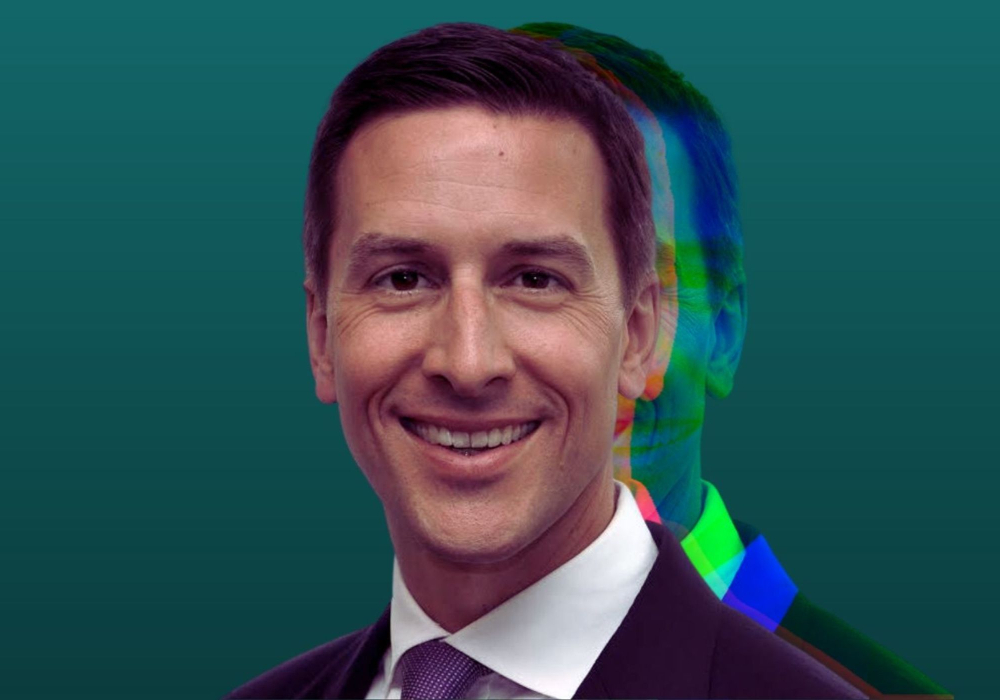
David Rawlings, CEO of JPMorgan Chase Canada, brings more than two decades of experience to one of the most competitive corporate environments in the world. In a wide-ranging conversation, he unpacks the idea of the "corporate athlete," reflects on Canada's complicated relationship with entrepreneurial risk and explores how diversity, role models and allyship are reshaping the pipeline for the next generation of leaders in both business and sport.
There is a phrase David Rawlings uses that tends to stop people mid-thought. The CEO of JPMorgan Chase Canada, a man with two decades at one of the most relentlessly competitive financial institutions on the planet, describes senior corporate professionals not as executives or leaders but as athletes. Corporate athletes. And the more you sit with the analogy, the more it earns its weight.
"The corporate athlete is a thirty-year game, and we train 12 to 14 hours a day," Rawlings said during a conversation recorded ahead of the Chase Diversity Alliance panel titled The Black Experience in Sports and the Workplace. "Whereas a professional athlete is a six to eight-year game, and they train three to four hours a day. So to be a corporate athlete, it takes real longevity."
Strip away the metaphor, and what remains is something more substantive than a motivational soundbite. Rawlings is describing a fundamentally different way of thinking about career development, one that frames professional endurance, discipline and the willingness to compete daily as the real prerequisites for reaching and sustaining seniority at the highest levels. At JPMorgan Chase, a global firm of more than 250,000 employees operating across over 100 countries, that framework is not rhetorical. It is the operating reality.
A career built on competition and cross-border perspective
Rawlings came up through Bear Stearns, which was acquired by JPMorgan. He spent a decade in New York before returning to Canada, where he has led the firm's Canadian operations for the past ten years. That cross-border career gives him a vantage point that is genuinely useful when the conversation turns to culture, risk and what separates markets from one another.
New York, he is careful to note, is not the United States in the way that Toronto is not all of Canada. But the contrast he draws is still instructive. New York is, in his words, "full on." The commercial energy is relentless, the competitive dynamics are visible on every block, and perhaps most strikingly, the social culture around entrepreneurship is supportive in a way that Canada has historically not managed to match.
"If you're starting a business in New York, the rhetoric around that was: that's amazing, I'm so proud of you, what can I do to support you?" Rawlings said. "When I look at it relative to Canada, I'd say we lag from that point of view. The conversation in Canada is a little more conservative. 'Are you sure that's a good idea? Have you thought about the risks? What if you fail?"
Canada's risk aversion problem; time to name it honestly
This is not a new observation, but it carries more weight coming from someone who has lived and worked on both sides of the 49th parallel at a senior level. Canada has long prided itself on prudence, on stability, on not swinging too far in any direction. Those qualities have genuine value. The Canadian banking system's relative resilience through the 2008 financial crisis is a legitimate point of national pride, and the conservatism of Canadian institutions has often protected the country from the worst of speculative excess.
But that same conservatism has a shadow side. It manifests in a cultural reluctance to celebrate ambitious failure, in a tendency to counsel caution over courage, and in a venture and startup ecosystem that, for all its growth over the past decade, still punches below Canada's weight relative to comparable economies. Rawlings acknowledges the improvement, calling out the real push around technology and entrepreneurship that has emerged in recent years. He is genuinely excited about it. But the gap remains.
The entrepreneurial question also intersects directly with the broader conversation about equity and access to capital. During the discussion, Rawlings reflected on the specific challenges Black Canadians face in building relationships with financial institutions and in accessing the capital needed to generate generational wealth. He was candid that his own career has been concentrated on the institutional side of the business, not retail banking, so he was careful not to overreach. But he was clear that proximity to diverse communities, both physical and cultural, is not a nice-to-have for financial institutions. It is a prerequisite for genuine trust.
If Canada's risk-averse culture makes it harder for any entrepreneur to get a fair hearing, that effect is compounded for founders and borrowers from underrepresented communities, where existing wealth gaps, systemic bias, and historical exclusion from financial systems already narrow the margins. The question of who gets to take entrepreneurial risk in Canada is inseparable from who has access to the capital that makes risk survivable.
Sport as a mirror: What the ice reveals about the office
The Chase Diversity Alliance panel that occasioned this conversation was titled The Black Experience in Sports and the Workplace for good reason. The parallels between the two arenas are not incidental. They are structural.

The panel, hosted by former NHL player Anson Carter, brought together a remarkable group of voices including Willie O'Ree, the first Black player in NHL history and the man widely called the Jackie Robinson of ice hockey; Bryant McBride, founder of the Carnegie Initiative and producer of the documentary about O'Ree's life; and Saroya Tinker, a professional women's hockey player with the Toronto Six who spoke with unflinching honesty about confronting racism from childhood through her time as the first Black varsity player at Yale University.
Rawlings, though by his own admission not a hockey devotee, drew the connective tissue clearly. What sport does, he argued, is create conditions for what he calls "flow," the alignment of talent and effort toward a shared objective in real time, without the friction of hierarchy or credentials. Put ten people on a basketball court, and it doesn't matter whether you're the CEO or the analyst. The game levels everything.
"You'll just find that for certain players, you can get into this real flow very quickly," he said. "And that's the magic of the game."
The same conditions, he argued, are what organizations should be striving to create. The goal is not simply to assemble a diverse workforce; it is to build an environment where diverse perspectives actually enter the flow of decision-making, where they shape the advice being given to clients, where they change the outcome rather than merely the composition of the room.
At JPMorgan Chase Canada, roughly 40% of the workforce identifies as a visible minority, and a similar proportion are women. The firm's BOLD (Black Organization for Leadership and Development) chapter in Canada has grown steadily since its launch following the murder of George Floyd in 2020, growing from zero to around 50 members within a 500-person organization. More importantly, the initiative is structured not as a siloed employee resource group but as a deliberate pipeline program, with training, education, feedback, and a clear mandate to attract, develop and retain diverse talent.
The pipeline debate: Supply or demand?
One of the more persistent myths in corporate diversity conversations is the pipeline argument: the idea that there simply aren't enough qualified diverse candidates available to fill senior roles. Rawlings has limited patience for it, at least in the Toronto context.
"When you sit in the city of Toronto, you certainly don't think there's any issue finding unbelievably diverse talent," he said. "Fifty percent of this city are people who were not born in Canada."
The issue, in his view, is not supply. It is a process. Hiring managers need to build genuinely diverse slates for final-round interviews, because the math is unforgiving: if only one of five finalists is from an underrepresented group, the statistical likelihood of that person being selected is low regardless of merit. The solution is not to lower the bar; it is to deliberately build the slate so that the bar is applied to a genuinely competitive and diverse field.
That said, he acknowledged that the pipeline challenge looks different across markets and roles. In certain parts of the United States, JPMorgan has found it necessary to build training programs from the ground up, hiring net-new candidates and developing them specifically for roles like financial advisor, rather than simply recruiting from competitors who are drawing from the same limited pool.
The lesson applies broadly. If the system that has historically produced candidates for senior roles was itself exclusionary, then hiring from that system without intervention is not neutral. It is a continuation of the exclusion by other means.
Role models and allyship: The long work
Rawlings was explicit about the role of allyship within BOLD and about his own position in that dynamic. As a non-Black executive, his job in relation to the initiative is not to take up space in the conversation but to grow the circle of support around it.
"My role is really just to be in the background and to support the conversation," he said of the panel. "I would love to have all of the other panellists take 95% of the airtime, because I think their stories are relevant and unique, and I think we're all going to learn a lot from them."
The more substantive contribution, as he sees it, is structural: advocating for diverse hiring practices, creating pathways, and ensuring that the support for BOLD extends beyond the Black community so that inclusion becomes a shared organizational value rather than a niche program.
Willie O'Ree's story captures an important reason this matters. O'Ree joined the Boston Bruins in 1958, becoming the first Black player in NHL history. He was, famously, not particularly focused on the significance of what he was doing. He wanted to play hockey. But the impact of his presence, and of his continued engagement with the game over the decades since, has been profound precisely because it gave others the ability to see themselves in a role that had previously appeared closed to them.
That mechanism, the role model as proof of possibility, functions the same way in corporate settings. It is why Saroya Tinker's pride in playing under two Black coaches, including the legendary Angela James, matters beyond the personal. And it is why having leaders like Shaunda Archibald, Executive Director of Client Delivery at Chase Merchant Services and head of BOLD Canada, in visible positions of authority is a strategic asset for the organization, not merely a diversity metric.
Where the long game leads
The "corporate athlete" framing is useful not just as a description of individual effort but as a frame for thinking about institutional responsibility. If the career really is a thirty-year game, then the decisions made about who gets access to development, mentorship, stretch assignments and sponsorship in the early stages have compounding consequences over time.
Canada's corporate sector is becoming more deliberate about this, as are its entrepreneurial ecosystems, its financial institutions and its cultural organizations. But deliberateness without urgency is still too slow. The talent is here. The diversity is here. The ideas are here. What has sometimes been missing is the willingness to compete fully, to build slates that actually reflect the city and the country, to replace "are you sure that's a good idea?" with "what do you need to make it work?"
Rawlings spent a decade in New York understanding what full-contact commercial culture looks and feels like. He returned to Canada and has spent another decade trying to build something great there. The corporate athlete, he would say, keeps showing up. The question for Canada, as a culture and as an economy, is whether it is finally ready to train at that level.