
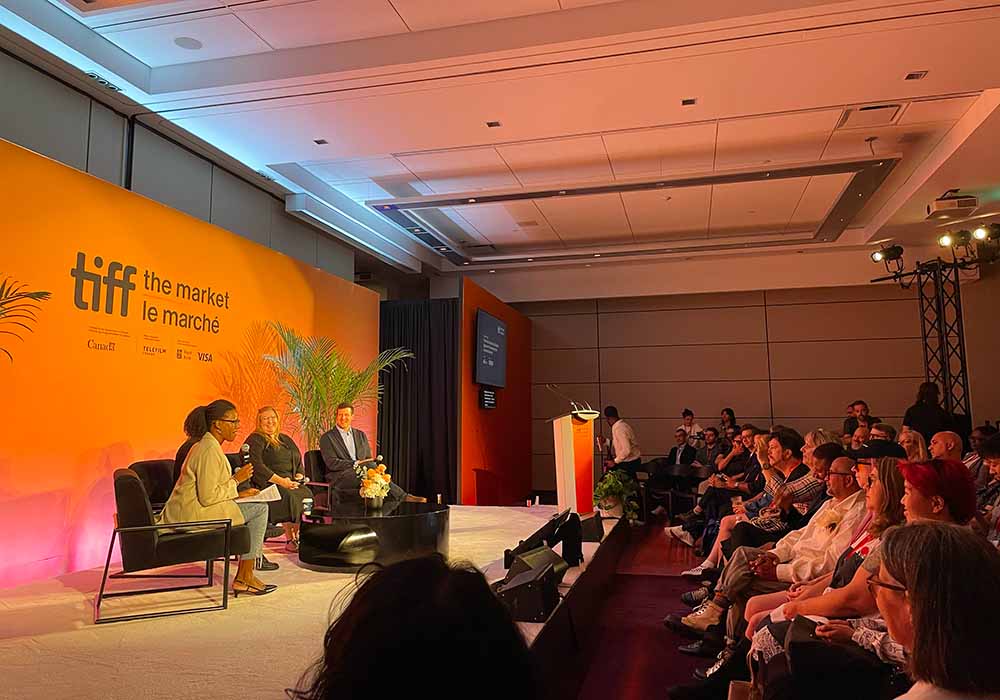
Recently, I attended TIFF 2026’s Perspectives from the Ground Up: Ontario’s Approach to Developing the Creative Economy, a panel examining how government, studios and industry organizations are supporting Ontario’s film and television sector. From production incentives and infrastructure to independent filmmakers, emerging media and Toronto’s diverse creative talent, the discussion offered a practical look at the people, programs and partnerships shaping the province’s creative economy.
I have spent some time observing and interacting with Toronto’s creative industries over the years, and one aspect I appreciated about this inaugural TIFF Market panel was its practical focus.
Rather than simply talking about Ontario as a destination for film and television production, the discussion looked at what actually happens on the ground.
How do filmmakers find support? How does the government justify continued investment? What makes Ontario competitive? And how can the province ensure that independent and homegrown storytellers benefit from an industry that also attracts major international productions?
The panel comprised moderator Claire Brooks, Executive Director of the Association of Film Commissioners International (AFCI), who was joined by Justin Cutler, Ontario Film Commissioner at Ontario Creates; Anthea Foyer of the City of Toronto's Creative Technology Office; and Melanie Loiselle, Director of Executive Operations at TriBro Studios.
One message came through particularly clearly: Ontario's creative economy has been built through a combination of government support, infrastructure, talent, accessibility and collaboration.
Making the economic case for creativity
Justin Cutler made the economic argument early in the conversation.
Ontario has strong support for film and television at the federal, provincial and municipal levels, he explained, but maintaining that support requires demonstrating the industry's economic impact. Job creation, production spending and activity across municipalities all help make the case for continued investment.
That economic argument is important because film and television are often discussed primarily as cultural industries. In Ontario, however, they are also a significant economic engine.
Cutler pointed to approximately 35,000 people working in the film industry in Ontario each year, with production activity extending well beyond Toronto into approximately 80 municipalities across the province.
The result is an ecosystem in which production is connected to communities throughout Ontario rather than concentrated entirely in the downtown core.
For me, that was one of the more interesting aspects of the discussion. The creative economy isn't simply about attracting a major production to Toronto. It is also about creating the infrastructure and relationships that allow productions to move through the province.
A concierge service for filmmakers
Cutler described Ontario Creates' Film Commission as effectively a concierge service for productions.
That can begin surprisingly early. Producers considering where to shoot can receive free location-scouting assistance, including image packages and in-person tours. From there, Ontario Creates can help producers navigate incentives, municipalities, production service companies, unions, transportation, accommodation and other logistical issues.
The important point is that this support isn't reserved for major international productions.
Cutler emphasized that the organization works with domestic producers as well as foreign productions, and that the goal is to make the process accessible from "script through to screen."
That idea was reinforced throughout the panel.
Melanie Loiselle spoke about TriBro Studios' work with productions ranging from student films and independent projects to mid-level productions and Tier A projects. The studio's approach is deliberately flexible, with the aim of helping filmmakers work within the resources available to them.
Her example of Station Eleven was particularly memorable. During the pandemic, TriBro took over an unused terminal near Pearson Airport, creating an unusual filming opportunity at a time when air travel had largely stopped. When travel resumed, the studio eventually had to give the location back.
It was a great example of how Ontario's production infrastructure can sometimes come down to the right people making the right connection at the right time.
Homegrown stories still matter
Another important thread was the balance between Ontario as a major production hub and Ontario as a place where local intellectual property can be developed.
Cutler said roughly 30 to 40 percent of Ontario's production volume is domestic, homegrown IP rather than foreign service production.
That distinction matters.
International productions bring jobs, spending and valuable experience into the province. But a healthy creative ecosystem also needs local storytellers developing their own projects, building careers and creating intellectual property that can travel beyond Ontario.
Ontario's funding programs are designed to support domestic content, while its tax-credit system can support both domestic and foreign service production. Cutler described the province's domestic incentives as competitive, including labour-related tax credits and additional federal support.
The challenge, however, is ensuring that independent producers actually know these opportunities exist.
That became one of the recurring themes of the conversation.
Opening the door to independent filmmakers
The panel made a strong case for filmmakers simply reaching out.
That sounds obvious, but it isn't always how the industry feels from the outside.
Independent and emerging filmmakers can understandably assume that government film offices, studios and other industry organizations are primarily there for established producers and large productions.
The panelists repeatedly challenged that perception.
Loiselle explained that TriBro is willing to work with filmmakers at different stages and budgets, while Foyer described the City of Toronto's role as helping people find the right connections, information and programs.
Cutler acknowledged that one of the biggest challenges is breaking through the perception that government agencies are inaccessible.
Ontario Creates is actively trying to address that by engaging with post-secondary institutions and introducing students to the resources available before they enter the industry.
That struck me as particularly important. Information about funding, locations, incentives and production support is only useful if emerging filmmakers know where to find it.
Toronto's diversity is an economic advantage
The panel also returned several times to one of Toronto's defining characteristics: its diversity.
Cutler pointed to the roughly 200 languages spoken in Toronto and argued that the diversity of the city's population is reflected throughout the production community.
Foyer made a similar point from the perspective of Toronto's gaming sector. Diverse communities create diverse creative voices, and those voices can produce work with relevance both locally and internationally.
She cited the example of a Toronto indie game focused on Chinese characters and culture, arguing that a story rooted in Toronto's communities can also connect with audiences around the world.
For me, this is one of the most compelling arguments for Toronto's creative economy. Diversity isn't simply a demographic statistic. It can become part of the creative infrastructure itself.
Film, television, gaming, technology, immersive media and the arts increasingly overlap. The presence of all these industries in the same city creates opportunities for talent and ideas to move between sectors.
Putting more on the screen
Another advantage discussed throughout the panel was Ontario's production infrastructure.
Cutler noted that the province has approximately 3.6 million square feet of soundstage space. But he stressed that support isn't limited to the largest facilities or productions with enormous budgets.
Regional incentives can also help productions stretch their resources. Cutler pointed to incentives for Northern Ontario, regional bonuses and examples of municipalities using accommodation-related taxes to encourage productions to film in their communities.
The underlying principle is straightforward: incentives can allow filmmakers to put more production value on screen.
That can make a difference to a domestic producer trying to move a project from an ambitious idea into something capable of competing at a higher level.
The next creative frontier
The conversation eventually moved beyond traditional film and television into gaming, immersive media, virtual production and podcasts.
Loiselle spoke about TriBro's movable virtual wall using Unreal Engine and plans to partner with a university to give students an opportunity to work with the technology.
Foyer talked about the growing connections between film, gaming, technology and immersive experiences, including TIFF's expanding presence in the digital space.
But podcasts exposed a different challenge.
Both the city and province acknowledged that newer forms of media can fall between existing funding categories. Podcasts, for example, may not fit neatly into traditional industrial or arts funding structures.
That doesn't mean the opportunity is being ignored.
Foyer encouraged creators working in emerging formats to make their needs known to government. The more clearly an industry demonstrates demand for support, the easier it becomes to make the case for developing appropriate programs.
Cutler similarly acknowledged that the province is thinking about how audiences built through podcasts, YouTube and other short-form platforms might connect with the broader film and television ecosystem.
That is an area I will be watching closely.
The advice I took away
An interesting audience question asked the panelists what they were excited about at TIFF and what advice they would give their younger selves.
The answers were revealing.
Loiselle emphasized networking and being willing to walk into a room where you don't know anyone. Foyer talked about staying open and curious. Cutler encouraged people to build relationships before they actually need them.
That last point resonated with me.
Creative industries are built on relationships, but the most valuable relationships aren't necessarily transactional. They develop over time, often through conversations that have no immediate outcome.
And that brought the panel back to where it began: building an ecosystem.
Ontario's creative economy isn't being built through one program, one tax credit or one major production. It is being built through connections between governments, municipalities, studios, unions, educators, producers, creators and the communities whose stories ultimately make their way onto screens.
After attending the panel at TIFF 2026, I came away with a clearer sense of why Ontario continues to be such a significant creative hub. The infrastructure is important, but the willingness to connect people and make the system more accessible may be just as important.
For emerging filmmakers especially, perhaps the simplest takeaway was also the most useful: reach out, ask questions, make connections and start building those relationships before you need them.